Loading...
Serving Palm Beach Gardens, FL and surrounding areas. (728) 529-5144
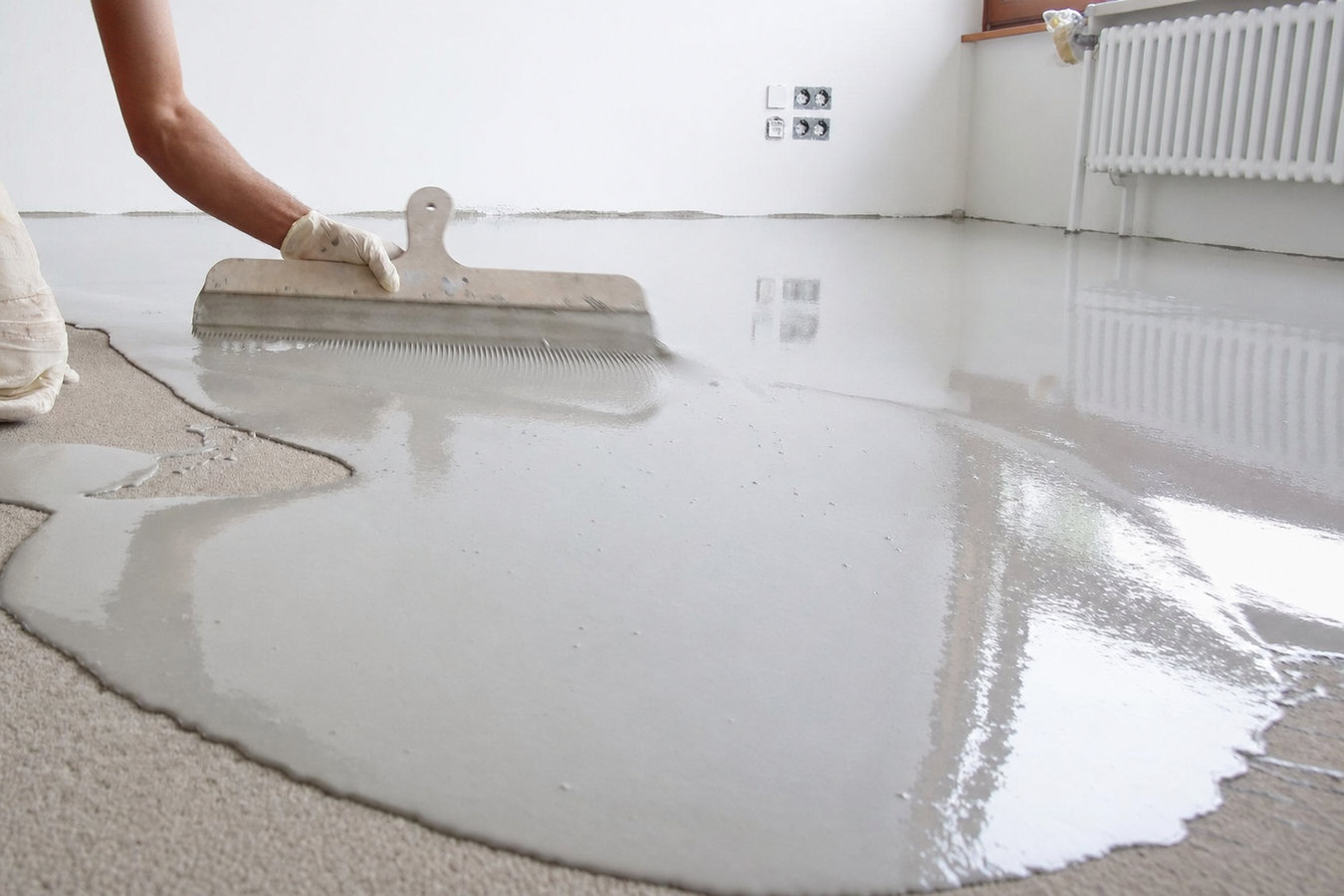
Uneven floors crack tile, cause flooring to fail, and get worse over time. We level your slab and apply overlays that bond to the surface - tested for moisture first, every single time.
Self-leveling concrete in Palm Beach Gardens is poured over an existing slab to fill low spots and create a flat, uniform surface - most interior residential pours are walkable within a few hours and ready for new flooring within 24 hours.
Nearly every home in Palm Beach Gardens is built on a concrete slab poured directly on the ground. Over years, Florida's sandy soil shifts and settles, and slabs develop low spots, surface cracks, and uneven areas - especially in homes built before 2000. When those problems appear, new flooring laid on top will flex, crack at the joints, or fail at the adhesive. Self-leveling concrete fixes the slab before the next floor goes in. If your surface is already flat but just looks worn or stained, a decorative concrete resurfacing and overlay may be the simpler solution.
Once the slab is level and cured, you can tile, lay hardwood or vinyl plank, or apply a decorative finish directly on top. Many homeowners in Palm Beach Gardens use this service as the foundation for a complete interior floor upgrade.
If you notice a dip or slope when you walk across a room - especially in older parts of your home - the slab beneath may have settled unevenly over the years. In Palm Beach Gardens, where sandy soils shift with seasonal rain and dry spells, this is more common than most homeowners expect. A self-leveling pour can correct those low spots before new flooring goes in, so you are not laying tile or vinyl over a surface that is already off.
When tile cracks in a pattern - diagonal cracks or cracks following grout lines - it is often because the floor beneath it is not flat or stable. In South Florida's humid climate, moisture moving through the slab can also cause adhesive to fail, which lets tiles shift and crack. If you are replacing tile for the second or third time in the same spot, the real fix is leveling the surface underneath, not just laying new tile on top of the old problem.
Concrete floors exposed to Florida sun, rain, and humidity deteriorate faster than floors in drier climates. If your garage floor or covered lanai looks rough, discolored, or is starting to flake on the surface, an overlay can restore it without a full tear-out. This is especially common in homes that are 15 or more years old, where the original sealer has long since worn away.
Most hardwood, luxury vinyl plank, and large-format tile manufacturers require the subfloor to be flat within a very tight tolerance - typically no more than three-sixteenths of an inch over ten feet. If your slab does not meet that standard, the new flooring will flex, creak, or crack at the joints. A self-leveling pour before installation solves this cleanly and the timeline stays predictable.
Every job starts with a moisture test. In South Florida, moisture vapor pushing up through the slab is the reason most overlays fail - and most homeowners do not find out until the bubbling starts. We test every slab before we pour anything and use a moisture-blocking primer when moisture is present. That step adds a little time upfront and saves you from starting over in two years. If the project also involves resurfacing an outdoor area, our pool deck coatings and resurfacing service handles the exterior surfaces at the same time so the work is coordinated.
After moisture testing and surface preparation - grinding or cleaning the existing floor so the new material bonds - we pour or apply the product that fits your situation. For floors going under new tile or hardwood, a standard resurfacing overlay may be the right companion service if you want a decorative finish rather than a neutral base. We walk you through which product fits your situation and why.
Suits homeowners who need a flat, stable base before installing hardwood, luxury vinyl plank, or large-format tile - corrects low spots quickly.
Suits interior floors and covered lanais where a refreshed, finished look is the goal - can be stained, polished, or left as a clean gray.
Suits Palm Beach Gardens slabs where moisture vapor testing shows elevated readings - a barrier primer is applied before the pour to prevent delamination.
Suits modern interiors and commercial spaces where a thin, seamless, stone-like appearance is wanted over an existing concrete or tile surface.
Suits garage and utility floors that are pitted, stained, or flaking - an overlay restores the surface without the cost of a full concrete replacement.
Suits covered outdoor surfaces where a slip-resistant, UV-stable finish is needed - popular in Palm Beach Gardens communities with large covered lanais.
Palm Beach Gardens is built almost entirely on slab-on-grade construction - no basements, very few crawl spaces. That means the concrete slab is the floor, and any settling, cracking, or moisture issue in that slab shows up directly in your living space. The city's sandy soils, high water table, and seasonal wet-dry cycles make slab movement more common here than in most parts of the country. Homes built in the 1970s through 1990s are especially likely to have developed low spots and uneven areas over the decades. Homeowners in West Palm Beach and Boynton Beach face the same slab conditions and regularly use self leveling concrete before installing new flooring.
The humidity factor cannot be overstated. Florida's subtropical climate means moisture vapor is always present in the ground below a slab, and it is always trying to push upward. Any contractor who does not test for this before pouring is skipping the step most critical to whether your floor lasts. We test every slab, document the reading, and make a decision based on actual conditions - not assumptions. For more context on slab moisture best practices, the American Society of Concrete Contractors publishes guidance on moisture testing and mitigation that reflects current industry standards. The South Florida Water Management District provides regional context on water table conditions that directly affect slabs throughout Palm Beach County.
We ask you a few questions about the space - the size, what is on the floor now, and what you are hoping to end up with. We reply within one business day and schedule a site visit. A contractor who quotes without looking at the floor is guessing - we do not do that.
We come to your home, measure the floor, check how uneven it is, and test for moisture coming up through the slab. This is the most critical step in Palm Beach Gardens. We also look at the condition of the existing surface to determine how much prep is needed. The real quote is built here.
The crew grinds and cleans the existing floor so the self-leveling material bonds properly. The pour fills low spots and spreads itself flat. A mid-sized room can be poured in a few hours - the prep work typically takes longer than the pour itself.
Most floors can be walked on carefully within a few hours and are ready for furniture after 24 hours. Your contractor gives you a timeline based on actual humidity conditions that day. Before the crew leaves, we walk the finished surface with you and cover what to watch for and how to care for the floor going forward.
We test for moisture before every pour. No obligation, no pressure. Reply within one business day.
Florida's water table is high and slabs here are under constant moisture pressure. We test every slab before we pour anything, document the reading, and use a barrier primer when moisture is present. Most of the overlay failures homeowners ask us to fix are the result of a contractor who skipped this test. We do not skip it.
One of the most common frustrations homeowners have is not knowing when the crew is showing up, how long they will be there, or when the floor is ready to use. We walk you through the timeline before we start and check in at each step. Drying times in Palm Beach Gardens' humid summers differ from product-label minimums, and we communicate the actual timeline - not the best-case scenario.
Florida requires contractors doing concrete work on residential properties to hold a current state license through the Florida Department of Business and Professional Regulation. You can verify our license yourself in minutes at the DBPR website before we ever set foot in your home. We carry liability insurance and workers compensation coverage and will provide proof on request.
We work in Palm Beach Gardens, Jupiter, Riviera Beach, and the surrounding communities regularly enough to know what to expect from slabs in this area - the soil conditions, the moisture patterns, and the age and construction type of the homes in different neighborhoods. That local experience saves time at the assessment and reduces surprises during the pour.
The homeowners who call us after a failed overlay from another contractor almost always describe the same story - no moisture test, minimal prep, and a floor that looked fine for six months before problems started. We built our approach specifically to avoid that outcome, and it shows in floors that still look solid years after we finish them.
Purpose-built coatings for pool decks that stay cooler, resist pool chemicals, and meet Florida slip-resistance requirements.
Learn MoreRefresh driveways, patios, and other outdoor surfaces with a fresh overlay applied directly over the existing concrete.
Learn MoreFall and winter book fast - Florida's dry season is the best time to schedule. Call now or request a free estimate online and we will follow up within one business day.